
Key Takeaways:
- Ethical non-monogamy is built on informed consent, honesty, communication, and respect.
- ENM includes open relationships, polyamory, swinging, solo polyamory, and other consensual relationship structures.
- Polyamory is a form of ethical non-monogamy that allows for multiple romantic and emotional relationships.
- Clear boundaries and mutually understood agreements are essential for making consensual non-monogamy work.
- Anyone considering ENM should discuss jealousy, sexual health, time, expectations, and changing feelings before opening a relationship.
allow romantic, sexual, or intimate connections with more than one person. Often shortened to
ENM, it isn't one specific kind of relationship. It's an umbrella covering everything from open relationships and swinging to polyamory and other arrangements built around informed consent.
That distinction matters. Non-monogamy without consent is generally considered infidelity. Ethical or
consensual non-monogamy, by contrast, requires people to talk openly about what is permitted, what isn't, and what everyone actually wants. The agreements can vary enormously from one relationship to another.
If you're wondering whether ENM could work for you—or simply trying to understand why more people are talking about it—start with one important idea: there isn't a universal ENM rulebook. There are principles, however, and understanding them before opening a relationship can prevent a lot of unnecessary confusion.
What Is Ethical Non-Moogamy?
Ethical non-monogamy describes relationships in which everyone involved knowingly agrees that romantic or sexual exclusivity isn't required. Researchers commonly use the closely related term
consensual non-monogamy (CNM), and the two terms are frequently used interchangeably.
The important part isn't how many people someone dates. It's whether everyone affected by the arrangement understands the relationship structure and freely agrees to it. Consent, honesty, communication, autonomy, and respect are what separate consensual arrangements from secret relationships.
In practical terms, ENM could mean a married couple occasionally dating other people. It could mean someone maintaining multiple committed romantic relationships. It might involve a couple exploring together, or a person independently developing relationships with several partners.
That flexibility is precisely why the terminology can become confusing.
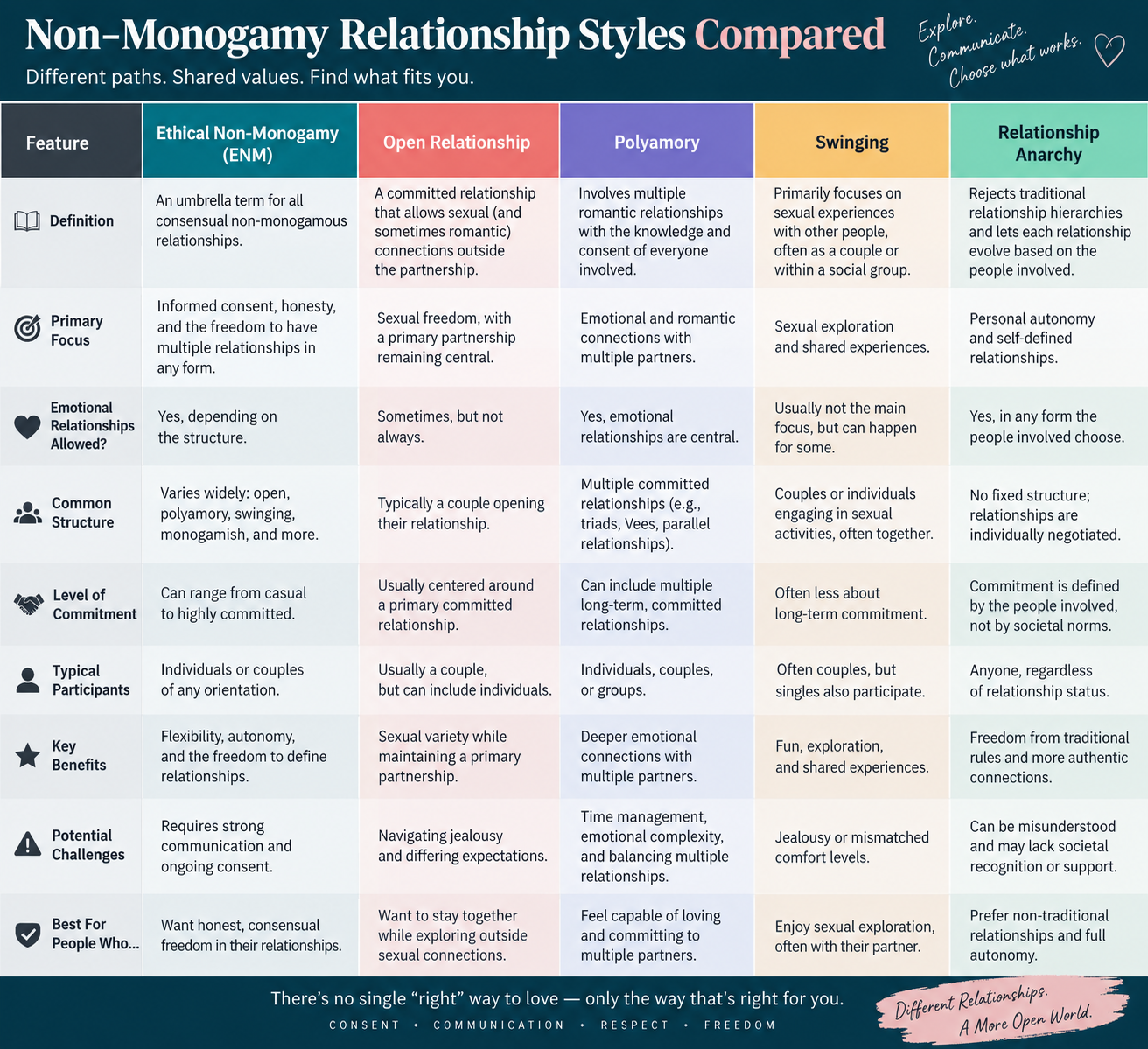
ENM is the umbrella. Polyamory, open relationships, swinging, and several other structures can sit underneath it.
Research suggests these arrangements are hardly unheard of. A review of research on consensual non-monogamy estimated that at least 5% of North Americans were currently participating in some form of CNM, while other studies have found considerably larger percentages reporting some lifetime experience with it.
Ethical Non-Monogamy vs. Cheating: Consent Changes Everything
People sometimes assume ENM is simply cheating with a different name. It isn't.
Cheating involves violating the agreements of a relationship. ENM involves establishing agreements that permit certain relationships or experiences with other people.
Here's an easy way to understand the difference.
If two people agree that neither will date anyone else and one secretly does, an agreement has been broken.
If those same two people mutually decide that dating others is acceptable within agreed boundaries, that's consensual non-monogamy.
There is another point beginners sometimes miss:
people in ENM relationships can still cheat.
If an open couple agrees that outside dating is permitted but overnight dates aren't, secretly spending the night with another partner could still violate their agreement. The issue isn't simply whether another person was involved. It's whether someone knowingly broke the relationship's agreements.
That makes communication unusually important.
Types of Non-Monogamous Relationships
There isn't one correct way to practice non-monogamy. Different structures prioritize different combinations of romantic connection, sexual exploration, independence, commitment, and partnership.
Two people can even use the same label while practicing it quite differently. That's why asking someone what a label means to them is usually more useful than assuming you already know.
Here are some of the most common
types of non-monogamous relationships.
Open Relationship
An
open relationship generally describes an established relationship in which partners agree that one or both may have sexual—and sometimes romantic—connections outside the relationship.
Some couples establish fairly specific boundaries. Others allow considerable independence.
The phrase therefore tells you relatively little about the actual rules.
Polyamory
Polyamory generally refers to maintaining, or being open to maintaining, multiple romantic relationships with the knowledge and consent of everyone involved.
Emotional relationships are often central to polyamory rather than merely permitted as an accidental consequence of sexual relationships.
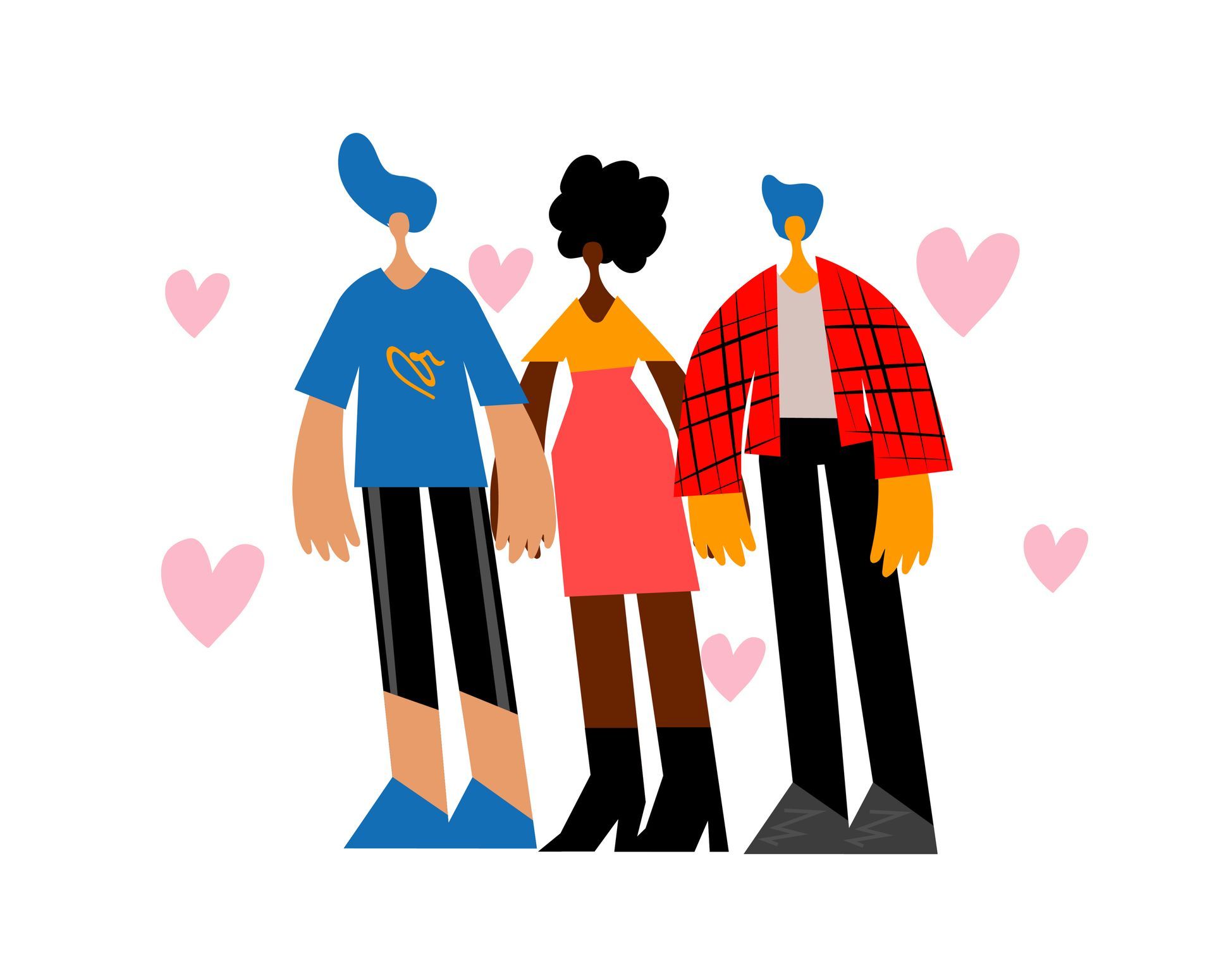
Polyamorous relationships can include many structures: hierarchical relationships, non-hierarchical relationships, solo polyamory, triads, interconnected networks, and others.
Swinging
Swinging typically focuses more heavily on consensual sexual experiences with other people, often involving couples who explore together or within a shared social environment.
Romantic relationships outside the established partnership aren't necessarily the objective.
Monogamish Relationships
Some couples consider themselves mostly monogamous while allowing occasional exceptions.
Those exceptions might involve particular situations, experiences while traveling, exploring together, or other specifically negotiated circumstances.
Relationship Anarchy
Relationship anarchy challenges the assumption that relationships must follow predetermined categories or automatically place romantic partnerships above friendships and other important relationships.
People instead negotiate individual relationships according to the needs and wishes of the people involved.
Solo Polyamory
Someone practicing solo polyamory may have multiple meaningful relationships while maintaining a high degree of personal independence.
Rather than organizing life around a single primary or nesting partner, they may prioritize autonomy, separate finances, separate homes, or other forms of independence.
These aren't rigid boxes. Real relationships frequently overlap categories or evolve from one structure into another.
Ethical Non-Monogamy vs. Polyamory: What's the Difference?
The easiest way to understand ethical non-monogamy vs. polyamory is to think in terms of categories.
Ethical non-monogamy is the larger category. Polyamory is one possible form of it.
Someone practicing polyamory is practicing consensual non-monogamy, but someone practicing ENM isn't necessarily polyamorous.
For example, imagine a married couple that permits occasional outside sexual experiences but agrees not to develop additional romantic relationships. That couple could accurately describe its relationship as ENM or open, but probably wouldn't describe the arrangement as polyamory.
Now imagine someone with two long-term partners whom they love and maintain committed relationships with. That arrangement could be described as polyamorous—and therefore also falls under ENM.
The distinction becomes especially useful when meeting people. Saying "I'm ENM" communicates a broad relationship orientation. Saying "I'm polyamorous" provides additional information about the possibility of multiple romantic relationships.
Polyamory vs. Open Relationship
The distinction between
polyamory vs. an open relationship can be subtle because both allow connections beyond conventional monogamy.
A useful starting point is to look at what kinds of connections the relationship is designed to accommodate.
Open relationships frequently emphasize permission for outside sexual relationships while retaining an established partnership as the central romantic relationship.
Polyamory explicitly allows multiple romantic relationships and the emotional attachment that can accompany them.
But don't treat that distinction as an absolute rule.
Some open relationships permit romance. Some polyamorous people have hierarchical partnerships. Others reject hierarchy entirely.
Labels are shorthand—not contracts.
Ask the people involved what their actual agreements are.
How Does Ethical Non-Monogamy Work in Real Life?
From the outside, ENM can look like simply removing exclusivity. In practice, successful consensual non-monogamy usually requires replacing assumptions with conversations. Monogamous couples often operate with numerous culturally understood expectations. Exclusivity may be assumed unless somebody says otherwise. ENM requires people to articulate expectations that otherwise might never have been discussed.
That means conversations about subjects such as:
- Who can we date?
- Are romantic relationships allowed?
- Are sexual relationships allowed?
- What information should partners share?
- What information should remain private?
- Are overnight dates comfortable?
- How will sexual-health decisions be handled?
- How much time is reserved for existing partners?
- What happens when someone develops stronger feelings?
- How are agreements renegotiated?
The answers don't have to resemble anyone else's. They do have to be understood
Rules, Boundaries and Agreements Aren't Exactly the Same Thing
One useful distinction missing from many beginner guides is the difference between a rule, a boundary, and an agreement.
They can sound similar but function differently.
A
rule attempts to control what another person can do.
A
boundary describes what you will or won't participate in.
An
agreement describes something people mutually decide to do.
Consider the difference:
Rule: "You can't spend the night with anyone."
Boundary: "I'm not comfortable remaining in a relationship where I'm routinely left responsible for our children overnight without advance planning."
Agreement: "We'll discuss overnight dates beforehand and make sure family responsibilities are covered."
Real-life situations are more complicated than those examples, but the distinction encourages people to talk about the underlying need instead of simply creating restrictions.
Research supports the importance of clarity. Studies of CNM relationships have found that relationship rules and sexual agreements aren't always understood identically by both partners. Explicit discussion can expose assumptions before those assumptions become conflicts.
The Skills That Make ENM Work
Having permission to date other people is the easy part to understand. Managing several people's needs, expectations, calendars, emotions, and sexual-health decisions is considerably more complicated.
Recent research examining how people maintain consensually non-monogamous relationships identified practices involving communication about jealousy, sexual-health maintenance, disclosure, distribution of resources between partners, and management of multiple relationships.
In everyday language, healthy ENM tends to require several skills.
Honest Communication
People need to be able to discuss uncomfortable subjects before they become emergencies. That includes attraction, jealousy, changing feelings, scheduling conflicts, sexual health, and dissatisfaction.
Consent That Can Change
Agreeing to something once doesn't mean someone permanently agrees to it. Consent should remain voluntary, informed, and capable of being reconsidered.
Someone who feels pressured to accept non-monogamy because they're afraid their partner will otherwise leave isn't starting from the same position as someone enthusiastically choosing it.
Time Management
Love might not be a finite resource, but Saturday night certainly is. Multiple relationships introduce practical limits involving work, children, travel, family responsibilities, friendships, rest, and existing partnerships. Calendars become surprisingly important.
Emotional Regulation
Jealousy doesn't automatically disappear because you've chosen ENM.
People can experience jealousy, insecurity, fear of replacement, envy, excitement, curiosity, relief, or several contradictory emotions simultaneously.
The useful question isn't always "How do I stop feeling jealous?"
It can be:
"What is this feeling trying to tell me?"
Maybe you need reassurance. Maybe an agreement isn't working. Maybe you're comparing yourself with another person. Maybe you simply need more quality time. Treating jealousy as information rather than automatic proof that the relationship has failed can lead to a more productive conversation.
Sexual Health in Consensual Non-Monogamy
Sexual health deserves more than the passing sentence it receives in many ENM explainers.
Having multiple partners can create different sexual-health considerations, but the number of partners alone doesn't determine someone's risk. Behaviors, testing practices, barrier use, vaccination status, communication, and the sexual networks involved all matter.
People considering ENM should discuss subjects such as:
- STI testing frequency
- sharing relevant test results
- barrier use
- contraception
- HPV and hepatitis vaccination where appropriate
- what happens if an exposure occurs
- whether changes in barrier use with one partner should be communicated to others
These conversations should happen
before they become urgent.
A healthcare professional can provide individualized guidance about testing and prevention based on someone's actual sexual practices and partners.
What About Jealousy?
Jealousy is probably one of the most searched questions surrounding ethical non-monogamy because people often imagine that ENM practitioners simply don't experience it.
Many do.
Some people also experience
compersion, a term commonly used to describe positive feelings about a partner experiencing happiness or intimacy with someone else. But compersion isn't an admission requirement for non-monogamy.
You don't fail ENM because you sometimes feel jealous.
The more useful skill is learning to identify what's underneath the emotion.
Imagine your partner starts seeing someone new and you suddenly feel threatened.
Instead of immediately creating another restriction, ask:
"Am I afraid of losing this person?"
"Do I feel neglected?"
"Have our routines unexpectedly changed?"
"Do I need reassurance?"
"Did something violate an agreement?"
Those questions turn jealousy from an accusation into information.

Meeting People When You're Practicing ENM
Dating while non-monogamous introduces another responsibility: disclosure.
Someone shouldn't discover after several dates that the person they've been seeing already has a partner or practices ENM. Relationship structure is information that can materially affect whether someone wants to participate.
Be clear early.
People exploring non-monogamous dating may meet through social communities, interest groups, events, or dating platforms where people can describe what they're looking for.
Platforms and communities built around adult social connection—such as
Cams.com—can also expose adults to conversations around alternative forms of connection and intimacy. People specifically seeking dating and relationship connections may also encounter ENM-friendly profiles on
Adult FriendFinder, where being direct about relationship status and intentions remains important.
The platform matters less than the honesty.
If you're partnered, say so.
If you're polyamorous, say so.
If you're only looking for casual connections, say so.
And if you're hoping another relationship might develop romantically, don't advertise it as purely casual.
Clear expectations save everybody time.
Should You Try Ethical Non-Monogamy?
Curiosity alone is a perfectly legitimate reason to learn about ENM. It doesn't obligate you to practice it.
Before changing an existing relationship, ask yourself a harder question than "Does this sound exciting?"
Ask
why you want it.
Are you genuinely interested in building a different relationship structure?
Are you attracted to more than one person and interested in exploring that honestly?
Do you value greater romantic or sexual autonomy?
Or are you hoping opening the relationship will repair problems neither of you wants to address?
ENM can change a relationship, but it shouldn't be treated as an automatic repair kit.
Opening a relationship introduces more relationships, more conversations, more scheduling and more opportunities for existing tensions to become visible.
Questions to Ask Before Opening a Relationship
Before anyone creates a dating profile, have the boring conversations.
They're usually more important than the exciting ones.
Ask each other:
Why are we considering this?
Do both of us actually want it?
What does "open" mean to each of us?
Are we comfortable with sexual relationships, romantic relationships, or both?
What information do we want to share afterward?
How will we protect time for our relationship?
How will we handle sexual-health decisions?
What happens if someone falls in love?
Can either person request that an agreement be reconsidered?
What happens if one person eventually decides ENM isn't right for them?
That last question deserves attention.
Sometimes people discover that they want fundamentally different relationship structures. Negotiation can solve many disagreements, but it can't guarantee compatibility.
Common ENM Mistakes Beginners Can Avoid
One of the biggest mistakes is creating dozens of rules designed to eliminate every uncomfortable emotion. You probably can't.
Relationships change. People surprise themselves. Attraction isn't particularly interested in paperwork. Instead of attempting to predict every possible situation, create a smaller set of clear agreements and establish a process for discussing situations nobody anticipated
.
Another common mistake is treating additional partners as supporting characters in the original couple's relationship. They aren't.
If you begin dating another person, that person has feelings, boundaries, expectations, schedules, and autonomy too.
This becomes particularly important when established couples enter non-monogamy. "Protecting the original relationship" shouldn't become an excuse for treating another partner as disposable.
A third mistake is moving too quickly.
Talking about opening a relationship on Tuesday and creating three dating profiles Wednesday can leave very little time for either person to understand what they've actually agreed to.
Education isn't hesitation.
It's preparation.
ENM Doesn't Guarantee Better—or Worse—Relationships
One persistent stereotype is that non-monogamous relationships must be less committed or satisfying than monogamous ones.
Research doesn't support such a simple conclusion.
Reviews of the scientific literature have found relatively little difference in relationship-quality measures between consensually non-monogamous and monogamous relationships overall. Researchers have also emphasized that CNM includes meaningfully different relationship structures, making broad generalizations difficult.
That doesn't mean ENM automatically works. It means relationship structure alone doesn't tell you whether a relationship is healthy.
A dishonest open relationship can be unhealthy. So can a dishonest monogamous relationship. A caring polyamorous relationship can be healthy. So can a caring monogamous marriage.
The more useful questions concern consent, compatibility, trust, communication, respect, and whether the arrangement actually works for the people living in it.
How to Start Exploring ENM Without Rushing Into It
You don't have to transform your relationship simply because you're curious. Start by learning.
Read about different relationship structures. Discuss hypothetical situations. Listen to experiences that don't resemble your own. Talk about jealousy, time, sexual health, privacy and emotional attachment.
Then define what each person means by non-monogamy. A person saying "I'd like an open relationship" could mean occasional sexual experiences outside the relationship. Their partner might hear "I want additional romantic partners."
Those are very different conversations. If you eventually decide to explore, move deliberately:
Make agreements.
Check in.
Revisit them.
And don't assume the relationship model you choose today must remain unchanged forever.
Some people move from monogamy to ENM. Some change from open relationships to polyamory. Some return to monogamy. Others discover that non-monogamy fits them extremely well.
The objective isn't to graduate from one relationship style into another. It's to build relationships the people involved knowingly choose.
People who want to meet adults already comfortable discussing nontraditional dating arrangements may also explore communities such as Adult FriendFinder, but disclosure still matters: state your existing relationship structure and what kind of connection you're seeking rather than assuming everyone shares the same definition of ENM.

What You Should Know Before Deciding What's Right for You
Ethical non-monogamy isn't simply monogamy with more people added. It changes the assumptions surrounding exclusivity and replaces many of them with explicit agreements. That's why communication is not a nice extra in ENM; it's part of the infrastructure. People need to understand what they're consenting to, what their partners expect, and how those agreements can change.
It also helps to remember that
ENM, polyamory, and open relationships aren't interchangeable terms. ENM or consensual non-monogamy is the broad umbrella. Polyamory generally makes room for multiple romantic relationships. Open relationships commonly describe established partnerships that permit some form of outside intimacy. Swinging, solo polyamory, relationship anarchy, and monogamish arrangements add still more possibilities. Labels help people communicate, but the actual agreements matter more than the label.
If you're considering ENM yourself, don't begin with rules about other people. Begin with conversations about yourselves. Talk about motivation, jealousy, privacy, time, sex, safer-sex practices, emotional attachment, independence and what would happen if either person's feelings changed. If those conversations feel difficult before opening the relationship, adding more people probably won't make them easier.
Most importantly, don't approach non-monogamy as something you need to succeed at. There isn't a prize for becoming polyamorous, just as there isn't one for remaining monogamous. Learn enough to make an informed choice, be candid with everyone affected by that choice, and allow yourself to discover that your answer might change. The healthiest relationship structure isn't the one that sounds most progressive, traditional, adventurous, or fashionable. It's the one the people involved can genuinely and consensually live.
Sources and further reading:
Research informing this guide includes peer-reviewed work on consensual non-monogamy, relationship functioning, communication, relationship agreements, sexual health, jealousy, and multiple-relationship maintenance published in Perspectives on Psychological Science and Archives of Sexual Behavior, along with contemporary clinical and educational literature on ENM terminology.
Frequently Asked Questions About first date conversation starters?
Can ethical non-monogamy work in a marriage?
Yes. Ethical non-monogamy can be practiced within a marriage when both spouses knowingly and voluntarily agree to the relationship structure. Some married couples date independently, while others establish arrangements that allow particular romantic or sexual connections outside the marriage. A marriage does not have to become less committed simply because it becomes non-monogamous. What matters is whether both spouses genuinely consent and continue communicating about expectations, commitments and changes in their relationships.
What does ENM mean on a dating profile?
ENM on a dating profile usually means ethical non-monogamy. It indicates that the person is open to having more than one romantic or sexual connection with the knowledge and consent of the people involved. However, ENM is an umbrella term, so the abbreviation alone does not explain someone's exact relationship structure. If you're interested in someone who identifies as ENM, ask whether they are currently partnered, what type of connection they're seeking and what existing agreements could affect a new relationship.
How common is ethical non-monogamy?
Ethical non-monogamy is more common than many people assume, although estimates vary depending on how researchers define consensual non-monogamy and which population is surveyed. Research has found that a meaningful minority of adults have participated in consensually non-monogamous relationships at some point in their lives. Because ENM includes several relationship structures—including polyamory, open relationships and swinging—there isn't one single prevalence figure that applies to every form of non-monogamy.
Can an ENM relationship last long term?
Yes. Ethical non-monogamous relationships can be long-term relationships, just as monogamous relationships can. Some people maintain open, polyamorous or other consensually non-monogamous relationships for many years. Longevity depends less on the ENM label itself than on compatibility, communication, trust, realistic expectations and whether the relationship continues meeting the needs of the people involved. Having multiple partners does not automatically make a relationship temporary.
What is hierarchical vs. non-hierarchical ENM?
Hierarchical ENM gives one relationship greater priority or certain established privileges. For example, spouses or nesting partners might share finances, a home, parenting responsibilities or decision-making commitments that other relationships do not share. Non-hierarchical ENM generally attempts to avoid automatically ranking one romantic relationship above another. Neither description tells you everything about a relationship, so people should discuss what hierarchy actually means to them rather than relying on the label alone.
What is a primary partner in ethical non-monogamy?
A primary partner is a term some non-monogamous people use for a relationship that receives particular priority or carries major shared commitments. Primary partners might live together, be married, share finances, raise children or make significant life decisions together. Not everyone practicing ENM uses primary and secondary labels, however. Some polyamorous and non-hierarchical relationships intentionally avoid ranking partners, making it important to ask how someone personally defines their relationship structure.
What is a nesting partner in ENM?
A nesting partner is a romantic partner with whom someone shares a home. The term describes a living arrangement rather than automatically indicating that the nesting relationship is more important than someone's other relationships. Two people might share a home because of children, finances, convenience or commitment while maintaining additional relationships. In some ENM relationships, a nesting partner is also considered a primary partner; in others, they are not.
What is NRE in polyamory and ethical non-monogamy?
NRE stands for New Relationship Energy, a term used to describe the excitement, attraction and intense focus that can occur during the early stages of a new relationship. NRE isn't exclusive to polyamory or ENM, but it can become particularly noticeable when someone develops a new connection while maintaining an established relationship. Recognizing NRE can help people enjoy a new relationship without unintentionally neglecting existing partners, responsibilities or commitments.
What if one partner wants ENM and the other wants monogamy?
If one partner wants ethical non-monogamy and the other wants monogamy, neither person should feel pressured into a relationship structure they do not genuinely accept. The couple can discuss what each person wants, why those preferences matter and whether there is any arrangement both can freely choose. Sometimes people find common ground; sometimes they discover a fundamental incompatibility. Reluctantly agreeing to ENM solely from fear of losing a partner is different from enthusiastically consenting to it.
Do you have to tell new partners that you're ENM?
Yes, prospective partners should be told about an existing non-monogamous relationship structure early enough to make an informed decision about becoming involved. Saying that you're ENM is a useful starting point, but disclosure should go beyond the abbreviation. Explain whether you currently have partners, what type of relationship you're seeking, how much time and emotional availability you have, and any existing agreements that could materially affect the new relationship. Clear disclosure helps people decide whether the relationship being offered is actually compatible with what they want.
AdultFriendFinder is a dating and social networking site for adults seeking casual connections, friendships, virtual fun, or something more adventurous.
We offer a welcoming space for open-minded individuals to explore their desires and connect with others who share their interests.
Who would you like to connect with?



RECENT ARTICLES