Key Takeaways:
- Polyamory allows for multiple consensual romantic relationships.
- Open relationships often allow outside connections within agreed boundaries.
- Ethical non-monogamy is the umbrella term covering multiple relationship styles.
- Consent, communication and clear agreements distinguish ENM from cheating.
- Relationship labels matter less than understanding each person’s expectations.
Polyamory and an
open relationship aren't simply two names for the same thing. And then there's
ethical non-monogamy, the broader term that can include both. If you've ever tried to understand the vocabulary of modern relationships, it's easy to see why people get confused.
Here's the quickest explanation:
ethical non-monogamy (ENM) is the umbrella; polyamory and open relationships are two ways people may practice it. Polyamory generally leaves room for multiple romantic or loving relationships. An open relationship generally describes an established relationship in which partners agree that connections with other people are permitted, often with a greater emphasis on sexual rather than additional committed romantic relationships.
That's the useful starting point. Real relationships, however, don't always fit perfectly into those definitions.
This guide explains the differences, where the categories overlap, the other types of non-monogamous relationships you may encounter, and—perhaps most importantly—why knowing someone's label doesn't necessarily tell you how their relationship actually works.
Polyamory vs. Open Relationship vs. Ethical Non-Monogamy: The Quick Answer
When people search for polyamory vs. open relationship, they're usually trying to answer a practical question: What's actually different about these relationships? The answer comes down primarily to scope, emotional expectations and the agreements between the people involved.
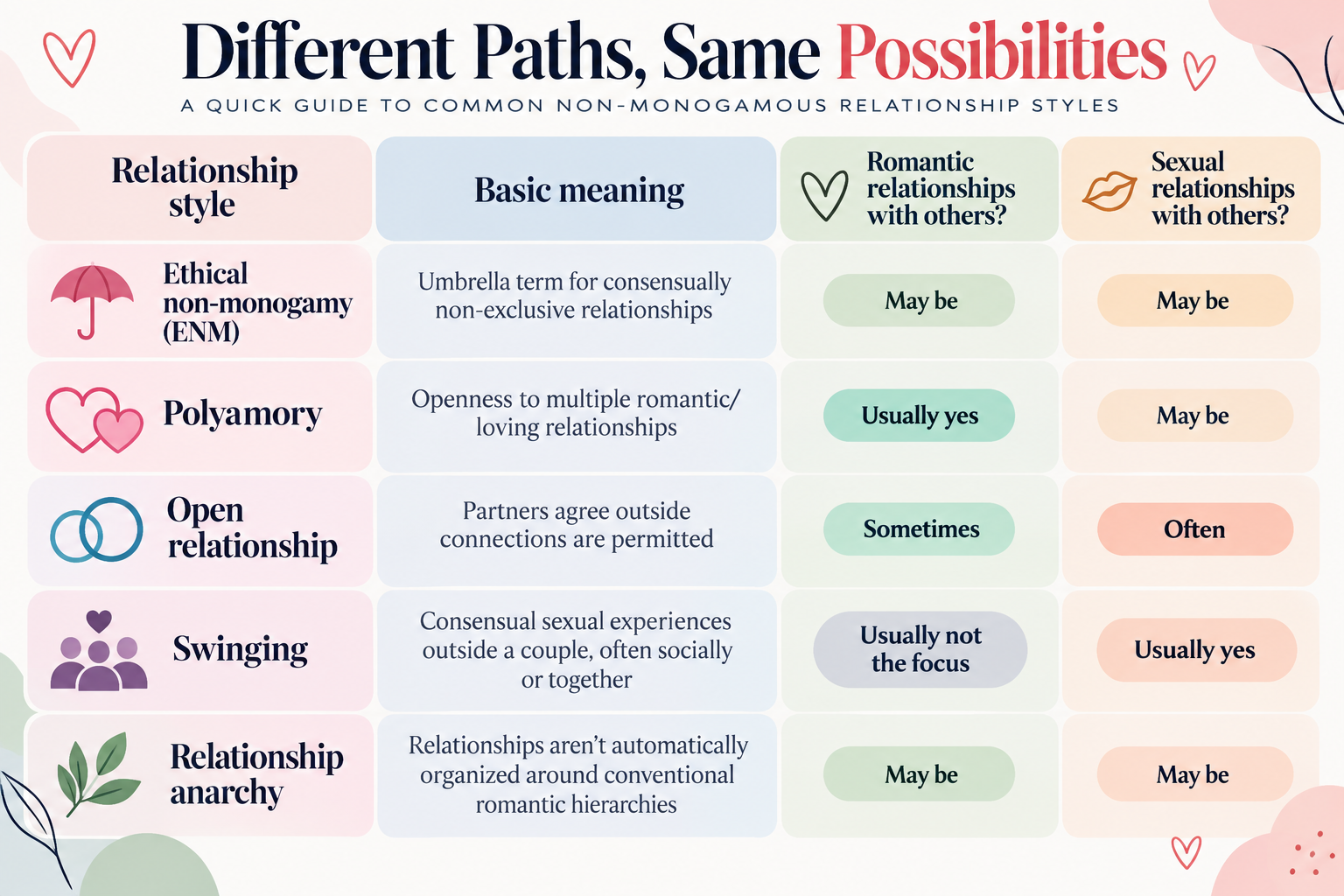
Think of ENM as a large category rather than one specific relationship model. Underneath it are numerous ways of organizing relationships, including polyamory, open relationships and swinging.
There is an important qualification to that table: none of these labels is a complete relationship agreement.
One person saying "I'm in an open relationship" might mean occasional casual encounters. Another might have an ongoing outside partner. Someone practicing polyamory might have two committed partners, while another may currently have one partner but remain open to additional romantic relationships.
The label gives you a starting point. The agreements tell you how the relationship actually works.

What Is Ethical Non-Monogamy?
Ethical non-monogamy describes relationships in which people knowingly and consensually allow some form of romantic, emotional and/or sexual connection involving more than one person. You'll often see it abbreviated as
ENM.
A closely related academic term is consensual non-monogamy (CNM). The terms are frequently used interchangeably, although researchers often favor CNM because consent can be described and studied more precisely than the broader concept of what counts as "ethical."
What makes an ENM relationship different from cheating isn't simply the number of partners involved. It's the presence of knowledge and consent.
If two partners have agreed that dating other people is permitted under certain conditions, that may be ENM. Secretly violating an exclusivity agreement isn't ENM simply because more than two people are involved.
ENM can therefore include:
- Polyamory
- Open relationships
- Swinging
- Some forms of relationship anarchy
- Polyfidelity
- "Monogamish" arrangements
- Other individually negotiated forms of consensual non-monogamy
Research suggests these relationship structures aren't especially rare. A U.S. study using two national samples of single adults found that roughly one in five respondents reported having engaged in consensual non-monogamy at some point in their lives. Other research reviews estimate that at least 5% of North Americans are currently participating in some form of CNM.
So when someone says they're "ENM," you still don't know exactly what their relationship looks like. You've learned the category—not necessarily the rules.
What Is Polyamory?
So, what is polyamory?
Polyamory generally refers to being open to having more than one romantic or loving relationship at the same time, with the knowledge and consent of the people involved. The word itself points toward its defining feature: the possibility of multiple loves.
Sex may certainly be part of polyamorous relationships, but sex isn't what makes a relationship polyamorous.
That's an important distinction.
A person could theoretically have deeply romantic relationships with two partners while having little or no sexual relationship with either. The romantic multiplicity—not a particular amount or type of sexual activity—is what places the arrangement within polyamory.
Polyamory can also take many forms.
Someone might have two partners who rarely interact. Three people might all date one another. A person may have an established nesting partner while maintaining another serious relationship with someone living elsewhere.
You may encounter terms such as:
Nesting partner: Someone with whom a person shares a home or domestic life.
Metamour: Your partner's partner when you aren't romantically involved with that person yourself.
Kitchen-table polyamory: A style in which partners and metamours are comfortable interacting socially.
Parallel polyamory: Relationships are kept relatively separate, even though everyone knows the other relationships exist.
Solo polyamory: A person maintains multiple relationships while prioritizing personal autonomy rather than building life around a primary couple.
Polyfidelity: A group agrees that romantic or sexual relationships remain within a defined group.
None of these structures automatically tells you who is "more important." Some polyamorous relationships use explicit hierarchies; others deliberately avoid them.
That's why the question "How many partners does a polyamorous person have?" misses something important. Polyamory describes the possibility and structure of multiple relationships, not a required number of partners.
What Is an Open Relationship?
What is an open relationship? At its simplest, it's a relationship in which partners agree that some degree of sexual, romantic or dating involvement with other people is allowed.
Traditionally, the term has often described a couple who remain romantically committed to one another while allowing sexual experiences outside the relationship. That remains common, but modern usage is broader. Some open relationships allow dating, emotional attachment or ongoing outside partners as well.
That's one place where overly tidy definitions fall apart.
Two people could both accurately describe themselves as being in an open relationship while following completely different agreements.
One couple might allow casual dating while traveling but not at home. Another may allow recurring partners. Another may be comfortable with sex but not romantic dating. Another might eventually develop relationships that look very similar to polyamory.
Open relationships therefore tend to be defined less by one universal rule and more by negotiated openness.
People exploring nontraditional dating may also encounter ENM-friendly communities and platforms such as adult friendfinder, where being clear about relationship status and expectations can help avoid mismatched assumptions.
The useful question isn't simply, "Are you open?"
It's:
"What does open mean to you?"
That question reveals considerably more.
Polyamory vs. Open Relationship: What's the Main Difference?
The clearest difference between polyamory vs. open relationship is usually the role romantic relationships outside an existing partnership are expected or permitted to play.
Polyamory generally recognizes the possibility of multiple meaningful romantic relationships. Open relationships often begin with an existing couple agreeing that some form of outside connection is permitted, frequently emphasizing sexual freedom.
But "generally" and "often" matter.
Some open relationships allow people to fall in love. Some polyamorous relationships have primary partners. Some people describe themselves as both polyamorous and open.
Instead of imagining two separate boxes, picture overlapping circles.
A practical example
Consider Alex and Jordan.
They are married and agree that either person can have casual sexual experiences with others, but they want romantic partnership to remain exclusive to their marriage.
They might describe their relationship as open.
Now imagine Maya. She has been dating Chris for six years and Taylor for three. Both relationships involve love, commitment, vacations, birthdays, emotional support and long-term planning.
Maya might describe herself as polyamorous.
Now change the first example.
Alex develops an ongoing relationship with Sam. Jordan knows about Sam, and everyone agrees that romantic relationships outside the marriage are acceptable.
At that point, "open relationship" may still accurately describe Alex and Jordan—but polyamory might also describe what they're doing.
That's why these terms can overlap.
Ethical Non-Monogamy vs. Polyamory: Are They the Same?
No. Ethical non-monogamy is broader than polyamory.
A helpful shorthand is:
All consensual polyamorous relationships can fall under ENM/CNM, but not every ENM relationship is polyamorous.
For example, a couple that occasionally attends swinging events may practice ethical non-monogamy without considering themselves polyamorous. They aren't necessarily looking for additional romantic partners.
Likewise, someone in an open marriage who occasionally has casual encounters might identify as non-monogamous without identifying as polyamorous.
This umbrella-versus-subcategory distinction is one of the easiest ways to understand the terminology.

Consensual Non-Monogamy vs. Ethical Non-Monogamy
You'll frequently see consensual non-monogamy and ethical non-monogamy describing essentially the same territory.
CNM emphasizes the feature that separates these arrangements from infidelity: consent.
That doesn't mean every decision made within a consensually non-monogamous relationship is automatically fair, considerate or healthy. Consent is essential, but relationships still involve questions about honesty, pressure, boundaries, responsibility and respect.
Healthy consent also isn't a one-time checkbox.
People can renegotiate agreements.
They can change their minds.
They can decide something that sounded comfortable in theory feels different in practice.
And everyone needs enough information to make meaningful decisions about what they're agreeing to.
Types of Non-Monogamous Relationships Explained
There isn't one correct way to practice non-monogamy. Different types of non-monogamous relationships prioritize different kinds of connection, independence and partnership.
Understanding these distinctions can be particularly helpful when dating because two people may both say they're "non-monogamous" while wanting entirely different things.
Polyamory
Allows or embraces multiple romantic relationships with everyone's knowledge and consent.
Open relationships
Partners agree that outside connections are permitted. These are frequently sexual, although emotional or romantic relationships may also be included depending on the agreement.
Swinging
Typically centers consensual recreational sexual experiences, often involving couples participating together or within a shared social environment.
Relationship anarchy
Challenges the assumption that romantic relationships must automatically outrank friendships or other meaningful connections. Individual relationships are negotiated rather than forced into conventional categories.
Solo polyamory
Someone may have multiple meaningful relationships while maintaining a highly independent life and not necessarily seeking a traditional primary or nesting partnership.
Polyfidelity
A defined group of people agrees to exclusivity within that group rather than exclusivity between two people.
Monogamish relationships
A mostly monogamous relationship allows limited exceptions negotiated by the partners.
These categories can overlap. Human relationships don't always respect vocabulary as neatly as search engines would like them to.
ENM Relationship Agreements: The Part Labels Can't Tell You
This is arguably more important than memorizing terminology.
Knowing that someone is polyamorous or in an open relationship tells you surprisingly little about what dating that person would actually involve.
Before entering an ENM relationship, people should understand the agreements underneath the label.
That includes questions such as:
Are additional romantic relationships allowed?
Someone may be comfortable with sexual experiences but uncomfortable with romantic attachment.
Are recurring partners okay?
A one-time encounter and a weekly date create very different relationship dynamics.
How much information does everyone want?
Some people want substantial transparency. Others prefer privacy while still requiring disclosure of information relevant to consent and sexual health.
Are overnight stays allowed?
Logistical questions become relationship questions surprisingly quickly.
How are safer-sex decisions handled?
People should discuss testing, barriers, contraception where relevant, risk changes and what information needs to be shared.
How much time is available?
One of the least glamorous realities of non-monogamy is also one of the most important: calendars.
Love may not be finite, but Friday night definitely is.
Multiple relationships require decisions about dates, holidays, travel, childcare, work schedules and ordinary downtime.
What happens if feelings develop?
This is especially important for open couples who originally intended outside relationships to remain casual.
People cannot always schedule emotion as neatly as they schedule dates.
Polyamory and Open Relationships Aren't the Same as Cheating
The dividing line isn't simply whether someone has another partner.
The crucial issue is whether the behavior falls within the relationship agreements everyone knowingly accepted.
A monogamous person secretly dating someone else is violating an exclusivity agreement.
A polyamorous person could also cheat.
For example, suppose someone agrees to disclose new sexual partners before having sex with an established partner again but deliberately hides one. The existence of non-monogamy doesn't erase the agreement that was broken.
This is why consensual non-monogamy is a particularly useful term.
The important contrast isn't:
monogamy vs. cheating.
It's:
agreed relationship structure vs. violation of that agreement.

Do Polyamorous and Open Relationships Actually Work?
There isn't credible evidence supporting the simplistic idea that one relationship structure automatically produces happy relationships while another automatically fails.
A research review on consensual non-monogamy reported little difference in overall relationship-quality measures between CNM and monogamous relationships. Research also emphasizes that CNM includes meaningfully different relationship structures rather than one uniform group.
That doesn't mean every open or polyamorous relationship works.
Neither does every monogamous relationship.
Relationship structure isn't a substitute for relationship skills.
Trust, compatibility, communication, honesty, emotional regulation and realistic expectations still matter.
Non-monogamy can also expose problems that were easier to ignore under exclusivity. Jealousy, unequal expectations, poor communication and time-management problems don't magically disappear because everyone agreed to ENM.
Sometimes they become more visible.
Jealousy in Polyamory and Open Relationships
A surprisingly persistent myth says people who practice polyamory simply don't experience jealousy.
Plenty do.
The difference is often in how people understand and respond to it.
Jealousy can contain several different emotions: fear of replacement, insecurity, loneliness, envy, uncertainty or concern about losing time and attention.
Simply saying "you're jealous" can obscure the actual issue.
Consider the difference between:
"I don't want you seeing Taylor."
and:
"We've canceled our date twice this month while you've had three dates with Taylor, and I'm starting to feel unimportant."
The second statement identifies a problem that can actually be discussed.
Sometimes the solution isn't another rule about outside partners. It might be keeping scheduled dates, improving communication or making sure one relationship isn't being neglected.
How Dating Changes When You're ENM
Dating while practicing ethical non-monogamy makes early clarity particularly valuable.
If you're already partnered, prospective partners deserve enough information to understand the relationship they're considering
entering.
That includes whether you have a spouse, nesting partner or other committed partners and whether there are agreements that could substantially affect a new relationship.
Someone searching for casual encounters has different expectations from someone looking for another committed relationship.
Dating environments where adults can state those intentions explicitly—whether through communities built around non-monogamy or established platforms such as adult friendfinder—can make that conversation easier.
People interested primarily in live online social or adult entertainment may encounter communities such as live cams, but online interaction doesn't eliminate the need to respect whatever agreements exist within an ENM relationship.
Transparency isn't about providing strangers with your entire relationship history.
It's about giving people information that materially affects their ability to consent to the situation they're entering.

Is Polyamory or an Open Relationship Right for You?
Instead of asking which relationship style is "better," ask what kind of connection you're actually trying to create.
Start without the terminology.
Would you be comfortable with your partner having sex with someone else?
Would you be comfortable with them falling in love with someone else?
Do you want multiple romantic relationships yourself?
Would you prefer outside connections to remain casual?
Would you be comfortable dating someone who already has another serious partner?
How much independence do you want?
How much time can you realistically give multiple relationships?
What information would you need to feel comfortable making your own choices?
Your answers may point toward polyamory, an open relationship, another form of ENM—or monogamy.
And that's precisely what these labels should do: help describe what people genuinely want rather than dictate what they are supposed to want.
What the Polyamory vs. Open Relationship Conversation Often Misses
Comparisons frequently reduce the issue to one sentence:
Polyamory is emotional; open relationships are sexual.
That's convenient, but reality is more complicated.
An open relationship can contain emotional attachment. A polyamorous relationship can contain casual connections. An open couple can become polyamorous without ending their original partnership.
The better framework is to examine several dimensions independently:
Romantic openness: Can people develop additional romantic relationships?
Sexual openness: Can people have sexual relationships outside existing partnerships?
Hierarchy: Are some relationships given formal priority?
Autonomy: How independently can each person make relationship decisions?
Disclosure: What information must be shared, and when?
Integration: Do partners and metamours socialize, or remain separate?
Commitment: Can outside relationships become long-term partnerships?
Resources: How are time, holidays, finances, housing and family responsibilities handled?
Two relationships using completely different labels can look remarkably similar when evaluated this way.
Conversely, two couples both calling themselves "open" may operate completely differently.
That's the piece worth remembering.
what You Should Know Before Choosing a Label
Polyamory, open relationships and ethical non-monogamy aren't competing versions of the same relationship. ENM is the broad umbrella. Polyamory generally emphasizes openness to multiple romantic relationships, while open relationships typically describe an established relationship that permits outside connections according to negotiated boundaries.
But vocabulary only takes you so far. If you're trying to understand someone's relationship—or decide what you want yourself—the most useful conversation begins after the label. Ask what kinds of emotional and sexual relationships are permitted, how partners communicate, what commitments already exist and what expectations would apply to someone new.
Consent is what separates consensual non-monogamy from secret violations of exclusivity, but good relationships require more than permission. They require people to communicate when circumstances change, take responsibility for agreements, respect the autonomy of everyone involved and recognize that new partners aren't merely accessories to an existing couple.
Perhaps the most useful takeaway is also the simplest: don't choose a relationship structure because the terminology sounds appealing. Work out what relationships you genuinely want, then find the language that describes them. Someone may discover that polyamory fits. Someone else may prefer an open relationship with carefully defined boundaries. Another person may decide monogamy suits them perfectly well.
Relationship labels work best as maps, not instruction manuals. They can help people find communities, communicate intentions and understand one another more quickly. But the relationship itself is built in the conversations behind the label—what people want, what they agree to, what they can realistically offer and how they treat one another when real life inevitably becomes more complicated than the definition.
Frequently Asked Questions About Polyamory, Open Relationships and ENM
Can you be polyamorous but only have one partner?
Yes. Polyamory doesn't require someone to have multiple partners at all times. A person can have one partner—or temporarily have no partners—and still identify as polyamorous because they are open to having multiple consensual romantic relationships. Relationship orientation or preferred structure and current number of partners aren't necessarily the same thing.
Can you be married and polyamorous?
Yes. Some married couples practice polyamory while maintaining their marriage and developing additional consensual relationships. Marriage may remain an important legal, financial or family partnership even when the spouses don't practice romantic or sexual exclusivity. The specific agreements surrounding outside relationships vary considerably between couples.
Can a monogamous person date a polyamorous person?
Yes, although this arrangement can present challenges if the two people want fundamentally different relationship structures. Sometimes called a mono-poly relationship, one person may choose to remain monogamous while the polyamorous partner has additional relationships. Clear expectations are particularly important because neither person should have to assume the other's preferred relationship structure.
What does "ENM" mean on a dating app?
ENM generally means ethical non-monogamy. Someone using ENM on a dating profile is signaling that they are open to consensual relationships involving more than one person. However, ENM doesn't tell you whether that person wants casual dating, sexual connections, multiple romantic partners or another arrangement. Ask what ENM means to them rather than assuming.
What is a polycule?
A polycule is the network of people connected through polyamorous relationships. Not everyone within a polycule necessarily dates or has sex with everyone else. For example, if you have two partners who aren't romantically involved with each other, the three of you can still form part of the same polycule through your interconnected relationships.
What is a metamour in polyamory?
A metamour is your partner's other partner when you and that person aren't romantically involved with each other. Metamours may become friends, interact occasionally or have little direct contact at all. How much metamours interact depends on the preferences and agreements of the people involved.
What does "primary partner" mean in polyamory?
A primary partner generally refers to a partner who has been given a particular level of priority or entanglement within a person's relationship structure. That might involve living together, marriage, children, shared finances or long-term planning. Not all polyamorous people use primary/secondary labels, and some deliberately structure their relationships without formal hierarchy.
Do all partners have to meet each other in a polyamorous relationship?
No. Polyamory requires informed consent, but it doesn't require every partner or metamour to socialize with one another. Some people prefer close interaction among partners, while others use a more parallel structure in which relationships remain relatively separate. What matters is that people have enough relevant information to knowingly consent to their relationships.
Is polyamory legal in the United States?
Having multiple consensual romantic relationships between adults is generally different from entering multiple legal marriages. U.S. law generally permits only one legal spouse at a time, although some municipalities have expanded domestic-partnership recognition to include polyamorous relationships. Legal recognition of multi-partner relationships remains limited and varies by jurisdiction.
What is polysaturation?
Polysaturation is the point at which someone has as many relationships or commitments as they can realistically manage. The limit isn't necessarily determined by a specific number of partners. Available time, work, family responsibilities, emotional energy and each relationship's needs all affect a person's capacity. Someone can therefore be polyamorous while deciding they currently don't have room for another relationship.
AdultFriendFinder is a dating and social networking site for adults seeking casual connections, friendships, virtual fun, or something more adventurous.
We offer a welcoming space for open-minded individuals to explore their desires and connect with others who share their interests.
Who would you like to connect with?




RECENT ARTICLES